Last week I attended the ICT4D conference in Nairobi, that brought together NGO's, donors and entrepreneurs to discuss how technology can be used for development - and how (and if) we are moving from innovation to impact.
Conversations across the conference ranged from the 'big picture' talk on concerns around the regulatory environment, connectivity and taking advantage of the disruptive power of technology, to very specific project talk including how to use mobile apps to support Community Health Workers.
In this blog, I want to reflect on a session I held during this conference, called Tech for open governance: where are we standing and where do we go?
Joining perspectives with Jessica Musila of Mzalendo Trust and Kwami Ahiabenu of Penplusbytes, we talked about where we stand as a sector, and how we can move it into more context-sensitive thinking, using existing evidence of what works and what doesn't in tech for development.
I believe we need to move beyond ideologically appealing narratives to examining what really happens in practice – because it is this practice that will truly push the sector to effective scaling of what works for meeting the Sustainable Development Goals, which was the strongly expressed agenda of the ICT4D conference.
If we're not careful, in another 10 years someone will be writing this very same blog. And we will not have learned from our successes, our failures and the new opportunities for collaboration that are emerging in this sector.
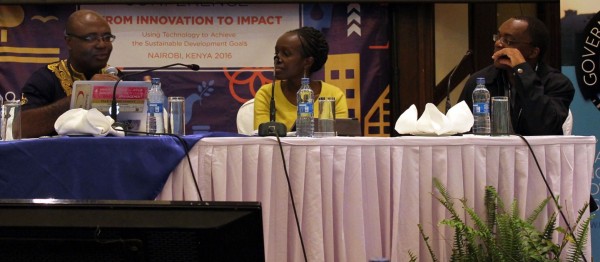
Kwami Ahiabenu (Penplusbytes), Jessica Musila (Mzalendo Trust) and Fletcher Tembo (Making All Voices Count)
Where are we coming from?
To understand where our sector stands today, we need to go back and reflect on our experiences of previous years.
We have seen a lot of T&A projects failing because they were designed without clearly saying how they think they will move from here to there and with what assumptions. They moved ahead with implementation without these theories of change being tested.
This approach makes it hard to monitor progress, to measure impact and show clear justifications of how each intervention contributes to change.
I have worked in this field for a long time, and recognise that often project leaders find it difficult to formulate a clear problem statement and what their intervention does to address the problem. They (we) tend to rush to and focus on the tech first, instead of the problem and the relevance of the tech to it. It might just be that tech is not the solution but that the solution lies in something else.
Too often, we often go straight into the what, without thinking about the why - with the result that a lot of T&A projects don't have a clear structure and suffer from 'conceptual vagueness'.
People often don't know how to go from where they are to where they want to be - fleshing out this path is key. We have been seeing examples or islands of success popping up in different spaces and instances – but what we need now is to start formulating the common factors of success that seem to make sense in different contexts.
Where are we now?
Slowly things are changing.
Experiences and learnings are being documented, and we start to get a better understanding of what it is that makes change happen. What could have been seen 10 years ago as a trickle of new technologies for T&A has turned into a flood – one which has substantially reconfigured methods, practices and understandings of how we work. The IDS 'Opening Governance' Bulletin has some great examples.
What should we focus on in the future?
In order to make change happen, I believe we need to:
- Focus on situations where we can push on open doors (where there is political will), recognising that tech initiatives are often not that good at opening closed doors by themselves; and that some of these open doors can close again depending on the circumstances;
- Take into account the political and cultural context. Technology is one thing, but we need to look beyond that. How do power relations work? What's the position of women or people living in rural areas? At Making All Voices Count, we often say: Tech is only 10% of the solution, the other 90% is working on relationships and building trust;
- Look for and support the real game changers in a given context, 'the interlocutors, of change'. These are individuals or organisations with the necessary game changing behaviour or attributes for that particular moment. They possess the credibility, connections and clout to mobilise groups, be listened to, to connect and get things going like no other organisation or individual can do for that context and moment (Tembo, 2015);
- Shape 'civic tech'. To make civic tech more effective, we need to bring the tech sector and the governance sector together re-create and re-define what we actually mean by civic tech – and how we each have a role to play. Organisations such as MySociety have argued for several years this is not a new field, and we all have a responsibility for helping it grow, and grow up.
Change won't happen quickly, but we need to be patient.
In the last 18 months before Making All Voices Count ends in November 2017, we'll be focussing more and more on learning and collecting evidence.
We'll be doing our best to contribute to this sector by forming learning partnerships, leaving nobody behind and making sure this evidence is both useable, and being used by our partners and others in the field.
Comments