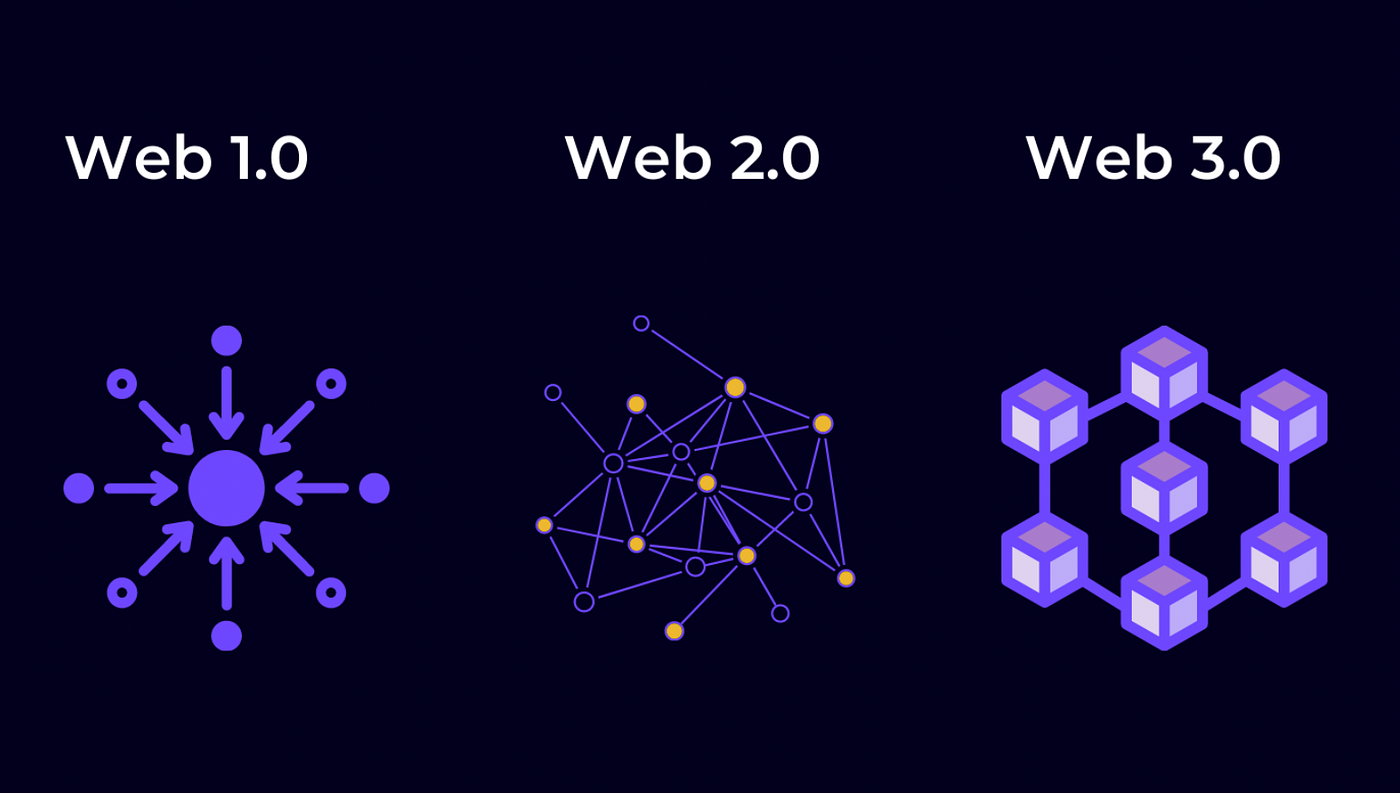
The certainty of change for everything, including the internet, is a given. The changes we witness in the evolution of the Internet means significant new exciting services are driving the growth of many online applications.
The first iteration of the Internet, web1 was static, made up of weblinks and homepages; then web2 came along, enabling users to create their own content seamlessly. Though web2 helped user content generation, the large tech companies providing services on the Internet had greater control and ownership of this user content. Web3 which describes the manifestation of a new iteration of the Internet anchored on blockchain technology, decentralisation and tokenisation among others, offers a unique opportunity to bring the Internet back to the control of users.
The term “Web 3.0” was coined by Gavin Wood, co-founder of Ethereum, in 2014 to describe his vision of the future of the Internet. Currently, web3 remains an evolving idea, and a work in progress therefore, it is difficult at this stage to pinpoint an exact definition. However, we can describe its vision as a new internet that relies on emerging technologies such as blockchain, and artificial intelligence to drive new services online based on a public ledger blockchain leading to machine-based data-driven and semantic Internet.
One key distinction of web3 is the shift of focus from online and social companies to Internet users since, in this context, they become the actual owners and managers of their personal data, and by extension, the Internet.
One variation of web3 could also be described as an Internet where cryptocurrencies and NFTs (non-fungible tokens) are integrated on the online planforms users make use of.
Web3 is characterized by four main elements namely openness, “trustless”, permissionless and ubiquity. One of the key features of web3 is openness; its design is based on an open-source software concept meaning it is community-driven by a group of developers with visibility in its protocol and pathway for new enhancements to be made to it with ease.
Secondly, web3 is permissionless, that is, there is no centralized controlling entity or individual, meaning all users can engage on the platform with no need for permissions. Also, Web3 runs on the principle of trust, which ensures the freedom of all users to interact with other users without the need for an intermediary or any third party, here all participants involved do not need to know or trust each other for the system to function. The core element of the system runs on “trustless” data, which removes the element of risks in a very robust manner.
Another key characteristic of Web3 is that it is ubiquitous, meaning it is available to the world at large without any limitation of time, location or device. For example, IoT (Internet of Things) technology supports the availability and development of a wide range of Internet on any type of device, giving them many intelligent functionalities.
The overriding application on web3 is tokenisation; any item can be tokenised, for example a building, work of art, social media output, tickets, music etc. The power of this sort of tokenisation is the creation of opportunities. For example, a work of art worth millions of dollars, can be tokenised and sold to multiple owners. In essence a work of art can have thousands of owners, instead of a single owner. These joint owners of the work of art, can freely trade or exchange their part of this art.
Secondly, web3 is expected to bring radical changes to the gaming industry where users can invest in their favourite games, giving them a chance to vote on how the game is operated. Using non-fungible tokens (NFT) can also facilitate irreversible ownership of games. Video games can be designed to reward players with NFTs and Ethereum-based cryptocurrencies if they win at aspects of a game.
One of the key criticisms of web3 is that, in reality, its notion of user ownership of the Internet through a blockchain network does not in fact guarantee end-user ownership, since big early adopters or investors can still maintain a single large ownership concentration defeating the promise of distributed ownership. In this sense, big companies can still maintain control and ownership of the Internet, making the idea of individual-owned Internet a pipe dream. Also, true decentralization will mean a leaderless community of protocols since leadership is distributed. In reality however, there is always going to be an influential figurehead such as on early adopter or even a project initiator.
In conclusion, web3 is moving from a mere idea to some form of reality, and although its promise of distributed ownership may be too idealistic, nevertheless, it holds a lot of potential to shape the Internet of the future.
The writer, Kwami Ahiabenu (PhD) is a Technology Innovations Consultant
First published by Graphic
Comments